
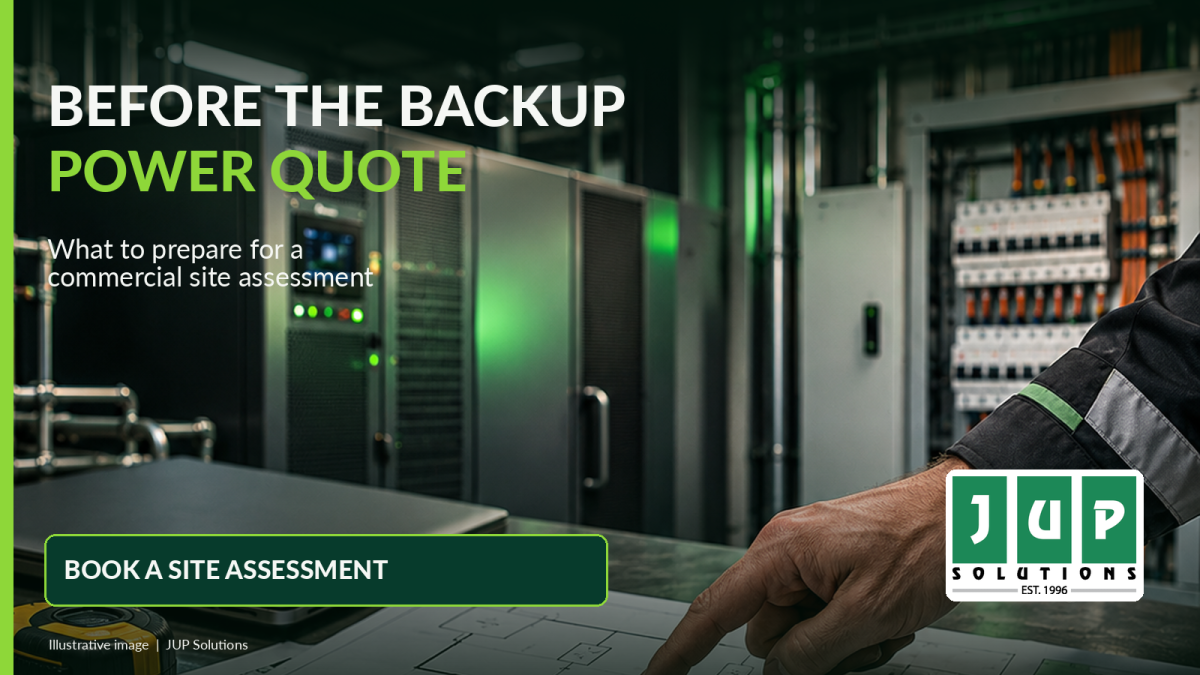
Start with the operation, not the equipment
When a business asks for a standby-power quotation, the first question is often, “What size generator or UPS do we need?” A useful answer requires more than an electricity bill or a list of equipment ratings. It requires an understanding of which operations must continue, how those loads behave and what the site can accommodate.
There is no need to manufacture urgency around national load shedding. Eskom’s 20 November 2026 power-system update reported sustained improvements and 553 consecutive days without national load shedding. That does not remove the practical reasons a facility may assess its continuity arrangements: local electrical faults, maintenance interruptions, power-quality problems and the consequences of an unexpected stop.
A good assessment starts with the business risk, then works towards an appropriate technical scope. Here are the details worth collecting before you ask for a proposal.
1. Identify the operations that actually need to stay live
Avoid starting with “the whole building”. Walk through what an interruption would mean for each team. A warehouse may need access control, dispatch scanners and network equipment, while a production line may need a controlled shutdown rather than full operation. A retail outlet could prioritise tills, network connectivity, security and selected refrigeration.
Separate critical, important but interruptible, and non-essential loads. Record the person who owns each decision, and ask what happens if that load is unavailable for one minute, fifteen minutes or several hours. This helps distinguish genuine continuity requirements from a wish list.
2. Record both running demand and starting behaviour
A nameplate kW or kVA figure does not necessarily tell the whole story. Motors and compressors can demand substantially more electrical input at start-up than during normal operation. Large starts and abrupt load steps can influence the generator, switching strategy and sensitive equipment sharing that supply. Caterpillar’s commercial generator guidance explicitly considers load steps, motor starts, voltage and frequency dip, and site conditions.
Capture a list of motors, pumps, compressors, HVAC equipment and large electronic loads, including model details and whether they start together or in sequence. Do not attempt live electrical measurements yourself. A suitably competent technician can obtain the information needed for a proper assessment.
3. Decide what interruption is acceptable
Some systems can tolerate a brief transfer; others cannot. For example, servers, communications and certain controls may need a UPS to bridge a supply interruption, whereas other plant may be suited to generator-backed power after changeover. The battery requirement also depends on how long a critical load must be supported and what happens next.
Record the acceptable interruption for each category in ordinary language: “must not reboot”, “must shut down safely” or “can restart after supply returns”. Chat to JUPS regarding the relationship between actual connected load, the UPS capacity and its battery runtime.
4. Understand your existing electrical arrangement
Useful starting documents include the most recent electrical single-line diagram, distribution-board schedule, utility bills, equipment lists and any available load or power-quality records. Note whether the building has one or several incoming supplies, and whether any existing UPS, generator, solar or battery system is connected.
If drawings are missing or outdated, say so. A site assessment can identify what requires verification. Never assume that equipment labels, old drawings and current wiring match without inspection.
5. Plan for access, ventilation, noise and maintenance
The proposed equipment must suit the physical site. Before discussing a generator location, identify access routes, loading restrictions, exhaust arrangements, airflow, neighbours, noise constraints, service clearances and fuel arrangements. For batteries and UPS equipment, ask about room conditions, ventilation, environmental controls and safe access for maintenance.
A lower-priced equipment quote is not necessarily a lower-cost installed solution if the site requires significant electrical, civil or ventilation work. Confirm these constraints with the relevant design and safety professionals before ordering equipment.
6. Be specific about solar and batteries
“Solar” and “backup” are not interchangeable requirements. A grid-tied PV system may support daytime energy use without necessarily supplying a facility when grid power is absent. Hybrid and off-grid designs, where appropriate, involve additional decisions about battery storage, inverter operating modes, protected circuits and the desired degree of independence.
For a realistic discussion, bring at least twelve months of electricity bills where available, operating hours, seasonal variation and a list of what must work outside daylight hours. The distinction between grid-tied, off-grid and hybrid solar offerings is also reflected in JUP Solutions’ solar solutions.
7. Clarify what is already installed and maintained
An existing generator or UPS should not be treated as a black box. Locate service records, previous fault reports, battery replacement dates, alarm histories and as-built documents. Include any known limitations or equipment currently out of service. A maintenance requirement may be more urgent than a new purchase, but that conclusion needs inspection rather than guesswork.
JUP Solutions lists maintenance services across UPS, generators, batteries and PV solar. The right maintenance scope depends on the equipment and the operating risk, not simply a calendar reminder.
8. Set the commercial and operational boundaries
A useful proposal should state what is included and excluded. Discuss budget expectations, installation access, allowable shutdown windows, internal approvals, health and safety requirements, and who will operate or maintain the system after handover. If phased implementation is acceptable, make that known early.
Also decide what a successful outcome looks like: critical IT remains online, production stops safely, essential services are restored in a defined sequence, or a particular operating period is covered. These outcomes are more meaningful than buying the highest kVA label.
9. Ask how the proposed solution will be checked
Before approving a quotation, ask the supplier to explain the assumed loads, start-up conditions, transfer arrangement, battery autonomy where relevant, site works, commissioning scope and handover documents. The answer should make sense to the facilities or operations team that will own the installation.
JUP Solutions describes industrial standby-power solutions and site-specific needs analysis, alongside dedicated UPS and generator offerings. Those are useful places to explore options before committing to a specification.
10. Bring one owner from operations and one from facilities
The person responsible for the electrical supply may know the infrastructure, but an operations manager knows the consequences of stopping a line, store or service. Having both perspectives in the discussion helps expose missing critical loads, unrealistic restart expectations and installation constraints.
A qualified assessment can turn that information into a practical design brief and quotation scope.
Book a Site Assessment
If your organisation is planning or reviewing commercial standby power, start with the loads that matter, the interruption you can tolerate and the site conditions. JUP Solutions can discuss UPS, generators, batteries, solar and maintenance requirements against your application. Book a Site Assessment via the live contact page, or use the website’s free nationwide number, 0800 JUP UPS (587 877). Please state your business, facility location, current equipment and the reason for your enquiry.
Share this Post