
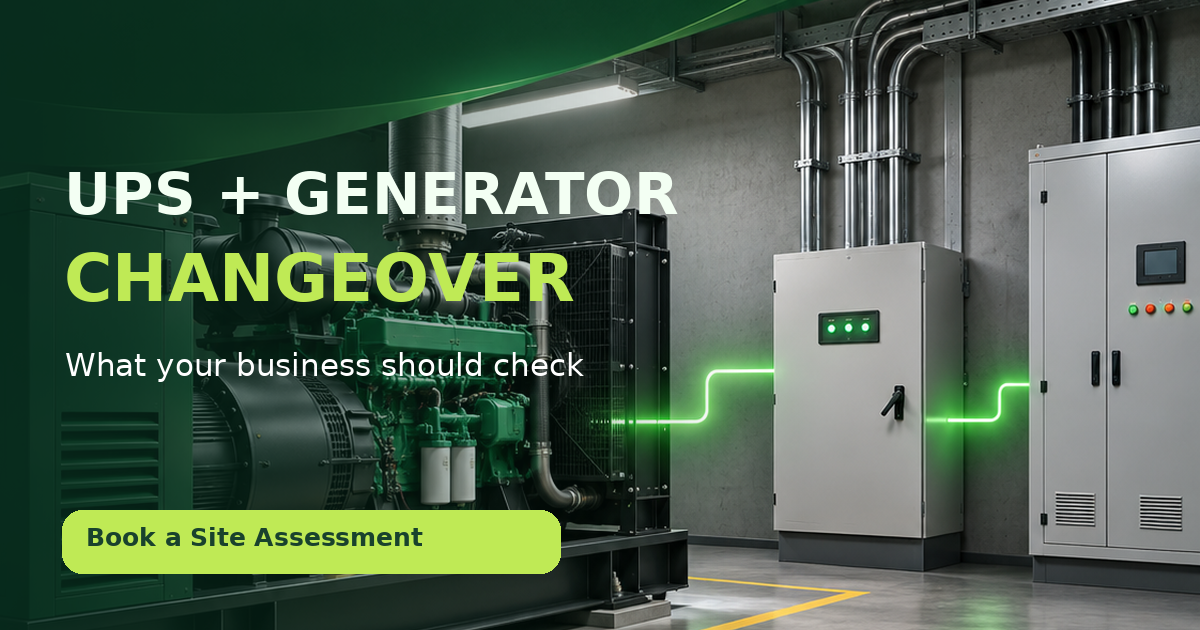
A business may own a UPS, generator and battery bank, yet still experience interruptions. The problem can be what happens between components: generator start-up, source transfer, UPS acceptance and return to mains power.
The better question is whether critical equipment remains protected through every stage of an interruption.
Understand the different jobs
A UPS (uninterruptible power supply) protects selected critical loads against supply interruptions and unacceptable power conditions. The behaviour depends on UPS topology. Online double-conversion equipment normally maintains its inverter-fed output without a transfer interruption when the incoming source fails. Other UPS designs can have a brief transfer interval. This distinction matters for sensitive IT, control or communications equipment, and should be checked against the manufacturer’s specification rather than assumed.
A standby generator provides an alternative electrical source once it has started and stabilised. It is not generally an instantaneous replacement for a UPS. A generator must start, reach acceptable operating conditions and connect through a correctly designed changeover system before it can take load. A UPS can support the essential circuits during that transition, provided its usable autonomy is sufficient for the actual sequence.
A battery bank stores energy, but storage capacity alone does not tell you what will remain operational. Inverter limits, battery condition, usable energy, equipment starting behaviour and control logic all affect performance.
For JUPS’s published service categories, see UPS supply and support, generator supply and standby batteries.
What happens when utility power fails?
An interruption triggers a sequence. Selected loads stay on UPS as designed; the generator starts and stabilises; the transfer arrangement moves appropriate loads; and the system later returns to mains power. The full sequence matters, including the return transition.
Each stage has possible failure points. A starter battery can be weak. The generator may start but produce power outside the UPS input tolerance. A transfer device may not operate as expected. More circuits than intended may have been added to the essential distribution board. The sequence needs to be designed and tested for the actual site rather than explained as a universal, fixed number of seconds.
Generator voltage and frequency can fluctuate during start-up and under changing load, affecting transfer arrangements and UPS operation. That is one reason why a system may appear healthy when running from mains yet behave differently on generator power.
Four questions to ask before you expand or replace anything
1. Which loads must never see a disruption?
Separate critical and non-critical circuits. Examples might include server and network equipment, communications, selected control systems or essential security functions. Ask the people responsible for operations what interruption each circuit can tolerate. A desktop printer and a production controller should not automatically receive the same backup specification. Some loads also require a safe and orderly shutdown, rather than indefinite operation.
2. Can the UPS support the actual changeover sequence?
Review the real operating load, UPS capacity, battery condition and measured autonomy. Check the full time from supply loss until the generator is ready to accept the specified load, including realistic contingency. Avoid relying on a runtime estimate taken when the batteries were new or when the site carried a smaller load.
3. Will the generator and UPS operate together correctly?
Check the generator’s ability to cope with connected loads, charging demand, load steps and the UPS input requirements. Voltage, frequency and waveform quality must be considered. The generator and UPS manufacturers’ recommendations should guide the design. A general sizing multiplier copied from another site is not a substitute for engineering the combination. Sometimes a UPS alternates between mains and battery modes because generator output is not acceptable to that UPS.
4. Are the batteries and controls still supported?
When a battery reaches replacement age or the same model is no longer available, it can be tempting to add a newer unit alongside the existing bank. That is not automatically safe or compatible. Battery chemistry, module age, electrical configuration, battery-management communications and the manufacturer’s approved combinations all matter. Manufacturer’s expressly caution against mixing old and new cartridges in specified Smart-UPS systems; Victron’s more recent guidance explains that allowable combinations vary by battery architecture and equipment rules. Neither recommendation should be applied indiscriminately to every customer system.
Why a generator that starts is not necessarily a generator that is ready
Successful engine starting is only one part of standby-generator readiness. The equipment must also supply acceptable electrical power at the required load and reliably execute the correct changeover and return sequence. A no-load engine run is not the same as a validated operation under site conditions.
Perkins recommends maintenance and appropriate load testing, not prolonged no-load running alone. Test scope and procedures belong with competent personnel following site safety controls and manufacturer instructions.
This is especially important for premises where the generator has not been called on regularly. A stable national electricity supply does not remove the need to confirm that a standby system is ready for the next local fault, planned outage or site incident.
Where does solar fit?
Solar PV can reduce dependence on purchased electricity when properly designed, and a hybrid system may include batteries and backup capability. But an ordinary grid-tied PV system should not be assumed to supply a site during an outage. The inverter architecture, protection, islanding arrangements and essential-load configuration determine what happens when the grid is unavailable.
A business with PV, an existing UPS and a generator therefore needs an integrated view of the system. The objective is not to install each technology in isolation but to agree on which loads each source serves, how the systems interact, and how maintenance or future expansion will be handled. JUPS’s published solar services and industrial backup-power services provide further context.
What should a useful site assessment cover?
A productive assessment begins with the business operation. It should establish the critical loads and the operational consequences of disruption, then review available drawings, equipment models, installed battery configurations, maintenance records and the intended changeover logic. The appropriate scope may include a competent technical inspection and an agreed, controlled functional test of the power sequence.
The outcome should identify known facts, remaining checks and options for quotation. The answer could be maintenance, control correction, battery replacement or a redesign, depending on the site.
JUP Solutions publishes needs analysis, maintenance and repairs as part of its work. If you are unsure how your UPS and generator behave together, Book a Site Assessment and describe the critical equipment, the existing backup system and any previous changeover problems. The aim is to define a solution before you commit to unnecessary equipment.
Share this Post