
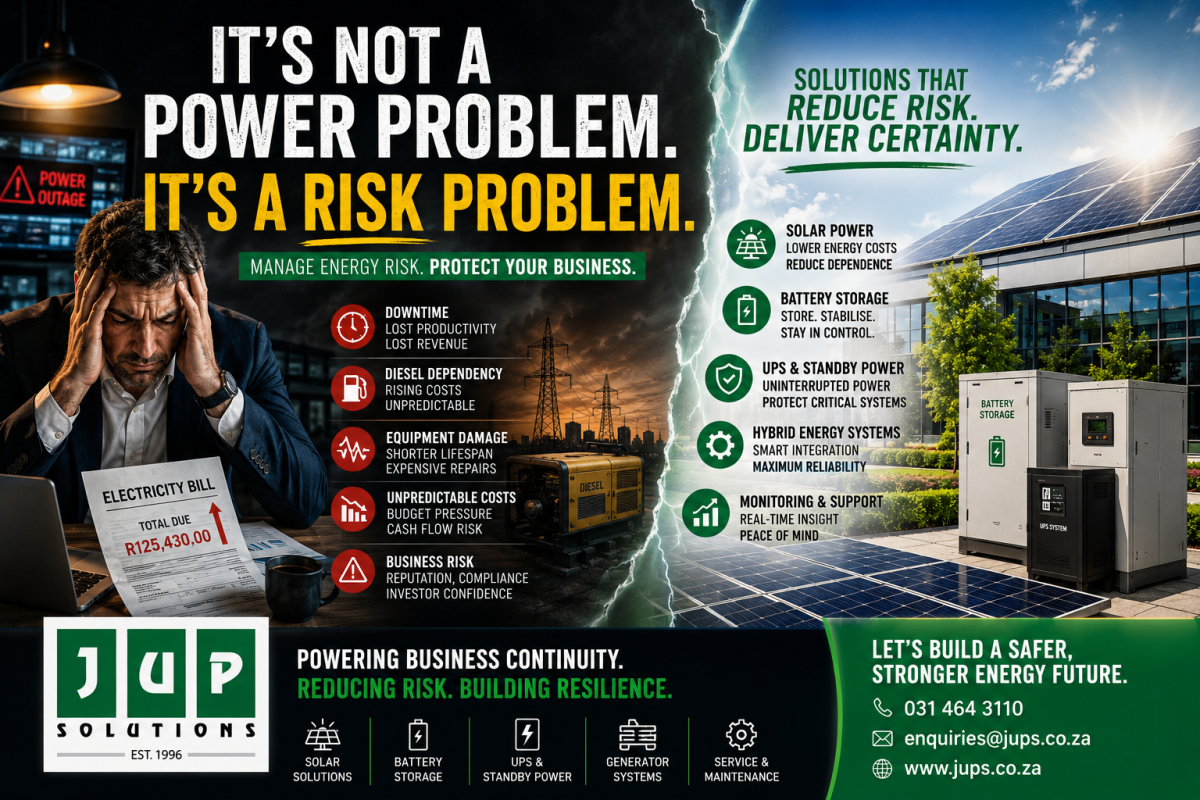
Why South African businesses need to rethink energy in 2026
Most businesses think they have a power problem.
They say things like:
- “Load-shedding is hurting us.”
- “Electricity costs are killing margins.”
- “We need backup power.”
- “We need a generator.”
- “We should probably look at solar.”
But that’s not the real problem.
The real problem is this:
Your business is carrying energy-related risk and most companies are underestimating how expensive that risk has become.
Power is no longer just a utility issue.
In 2026, it’s a business continuity issue.
What Energy Risk Actually Looks Like in Business
Energy risk doesn’t always show up as a blackout.
Sometimes it looks like:
- a server crashing unexpectedly
- a production line stopping mid-run
- staff sitting idle while systems reboot
- diesel costs quietly climbing every month
- refrigeration failing
- customer service systems going offline
- equipment failing earlier than expected
- operations becoming unpredictable
These aren’t “electrical issues.”
These are business risks with financial consequences.
💸 Risk #1: Downtime Is More Expensive Than You Think
When the power goes down, the cost isn’t just the lights.
It’s:
- staff productivity lost
- delayed orders
- interrupted processes
- customer frustration
- restart losses
- damaged output
- missed revenue
For many businesses:
One hour of downtime costs more than they realise.
And yet, most companies still haven’t properly calculated that number.
⛽ Risk #2: Generator Dependency Is Not a Strategy
Generators have helped South African businesses survive.
But survival is not the same as sustainability.
Generators come with:
- rising diesel costs
- maintenance requirements
- servicing downtime
- fuel logistics
- emissions concerns
- noise
- operational inefficiency
What once felt like security often becomes:
A second expensive utility bill.
Generators are useful.
But on their own, they are rarely a complete energy strategy.
🔥 Risk #3: Poor Power Quality Is Quietly Damaging Assets
This one is often missed.
Voltage instability, dips, spikes and switching events can lead to:
- damaged electronics
- shortened equipment life
- IT failures
- nuisance tripping
- process interruptions
- control system faults
Businesses often replace equipment without asking:
Was this actually a power quality problem?
Power doesn’t need to go off completely to cost you money.
It only needs to become unstable.
📉 Risk #4: Unpredictable Energy Costs Hurt Business Planning
High costs are frustrating.
Unpredictable costs are dangerous.
When businesses cannot accurately forecast:
- electricity spend
- diesel consumption
- outage-related losses
- maintenance costs
…it affects:
- cash flow
- pricing
- margins
- budgeting
- investment confidence
Energy volatility creates financial risk long before a blackout happens.
🌍 Risk #5: ESG and Investor Expectations Are Changing
This is no longer just about power.
Larger corporates, investors and financial institutions increasingly assess:
- sustainability
- resilience
- emissions exposure
- operational continuity
- infrastructure preparedness
Businesses with no energy strategy are beginning to look:
- less resilient
- less investable
- less future-ready
That matters more than many realise.
☀️ The Businesses Winning in 2026 Are Changing the Conversation
They’re no longer asking:
“How do we survive the next outage?”
They’re asking:
“How do we reduce our exposure to energy risk altogether?”
That shift changes everything.
🔋 Modern Risk Mitigation Looks Like This
Forward-thinking businesses are now building:
Grid-Tied Solar
To reduce cost exposure
UPS Systems
To protect sensitive equipment and ensure uninterrupted power
Battery Storage
To maintain critical loads and improve resilience
Hybrid Energy Systems
To intelligently combine solar, battery, grid and generator systems
Monitoring & Analytics
To improve visibility and reduce surprises
This Is No Longer About Backup Power
This is about:
- continuity
- resilience
- predictability
- cost control
- asset protection
- operational confidence
Backup power is just one piece.
Energy strategy is the bigger picture.
What JUP Solutions Does Differently
At JUP Solutions, we don’t just install equipment.
We help businesses reduce energy-related risk through:
- proper system design
- load analysis
- standby power engineering
- solar integration
- hybrid energy architecture
- power quality solutions
- long-term maintenance and support
Because your power system should not just work when things are normal.
It should work when your business is under pressure.
Final Thought
Most businesses think they have an electricity problem.
What they actually have is:
A growing operational risk problem tied to energy instability.
The companies that understand this early will:
- reduce costs
- improve resilience
- protect assets
- and operate with greater confidence
The ones that don’t?
Will keep reacting.
📞 Let’s Talk About Your Risk Exposure
If you want to understand what power instability is really costing your business, let’s assess it properly.
📞 031 464 3110
📧 enquiries@jups.co.za
🌐 www.jups.co.za
JUP Solutions
Powering business continuity in an unpredictable world.
Share this Post