
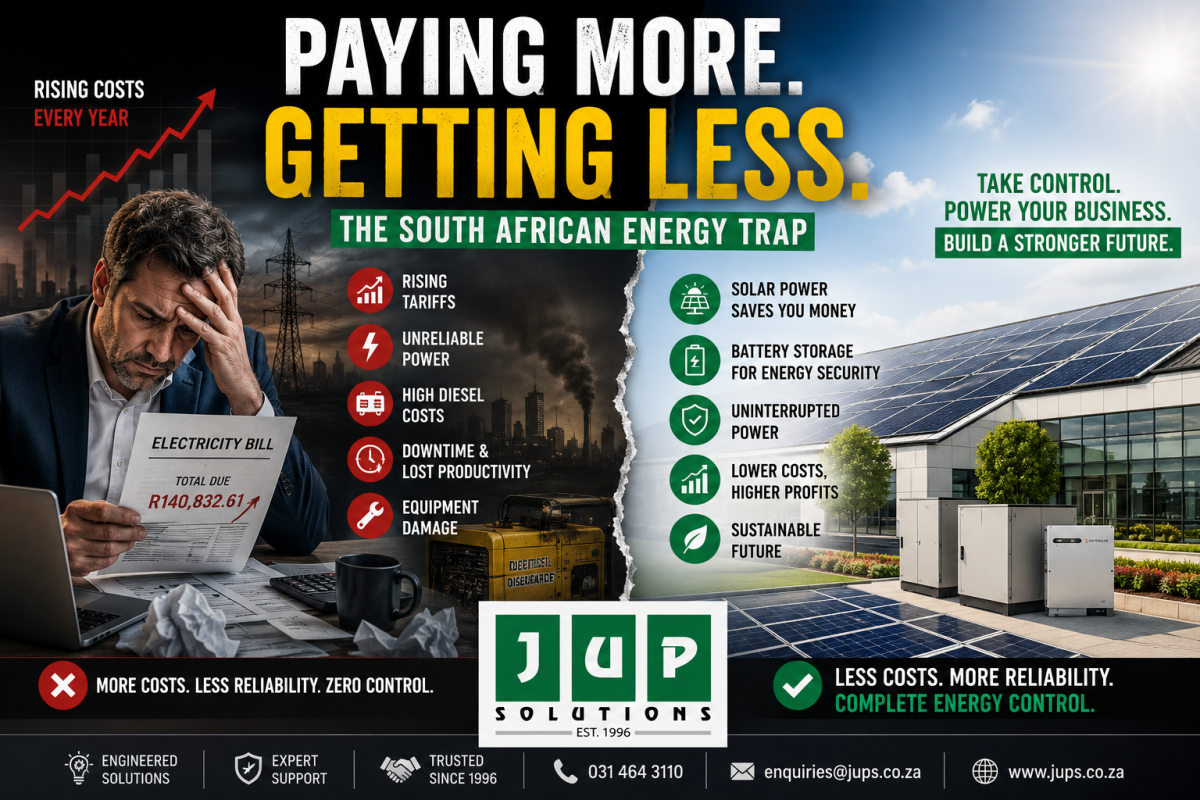
Why Businesses Are Paying More Every Year But Getting Less Reliability
For years, South African businesses accepted one simple trade-off:
Electricity might be expensive… but at least it was reliable.
That trade-off is gone.
In 2026, businesses across South Africa are facing a growing reality:
- Electricity costs keep rising
- Grid reliability keeps declining
- Diesel costs remain volatile
- And operational pressure is mounting
Many companies now find themselves trapped in an energy cycle where they’re paying more every year — while getting less value in return.
And the most dangerous part?
Most businesses still treat this as a temporary problem.
It isn’t.
Rising Costs Are No Longer the Exception — They’re the Pattern
Electricity increases are no longer surprising.
They’re expected.
Over the last decade, South African businesses have absorbed:
- repeated Eskom tariff hikes
- municipal markups
- rising fixed charges
- peak demand penalties
- and increasing fuel costs linked to backup generation
For many businesses, energy has quietly become one of the largest uncontrolled operational expenses on the balance sheet.
Yet despite paying significantly more:
- outages still happen
- infrastructure remains strained
- voltage instability damages equipment
- and businesses are expected to simply “adapt”
The Real Cost of Unreliable Power
Most companies only calculate:
“What is our electricity bill?”
Very few calculate:
“What is unreliable power actually costing us?”
That hidden number includes:
🔻 Downtime
Every interruption affects:
- productivity
- output
- staff efficiency
- customer experience
- operational flow
🔻 Generator Dependency
Generators solved yesterday’s problem.
Today they create new ones:
- diesel costs
- maintenance expenses
- servicing downtime
- noise and emissions concerns
For many businesses, generators have become an expensive crutch rather than a sustainable strategy.
🔻 Equipment Damage
Poor-quality power leads to:
- premature equipment failures
- server instability
- tripping systems
- damaged electronics
- shortened asset lifespan
These costs rarely get linked back to energy instability but they should.
🔻 Budget Uncertainty
One of the biggest business killers isn’t high costs.
It’s unpredictable costs.
When energy spend becomes volatile:
- forecasting becomes difficult
- margins shrink
- planning suffers
- confidence drops
Why Smart Businesses Are Moving Toward Energy Control
Forward-thinking businesses are no longer asking:
“How do we survive load-shedding?”
They’re asking:
“How do we reduce dependence on unstable infrastructure altogether?”
That shift changes everything.
Instead of reacting to the grid, businesses are now investing in:
- grid-tied solar systems
- hybrid power infrastructure
- battery storage
- UPS protection
- intelligent load management
The goal is no longer just backup.
It’s control.
The Rise of Hybrid Energy Systems
One of the biggest trends in 2026 is the move toward integrated energy systems.
Not:
- solar only
- generator only
- battery only
But systems designed to work together intelligently.
A properly engineered hybrid solution can:
✅ reduce electricity costs
✅ lower diesel consumption
✅ improve uptime
✅ protect critical infrastructure
✅ increase operational predictability
And importantly:
✅ create long-term financial resilience
Real-World Example
Consider a medium-sized commercial business:
Before:
- Monthly electricity spend: R140,000
- Generator diesel: R18,000/month
- Frequent downtime disruptions
After implementing:
- Grid-tied solar
- Structured standby backup
- Intelligent load prioritisation
Result:
- Electricity spend reduced significantly
- Diesel runtime reduced dramatically
- Better operational continuity
- More predictable monthly costs
Over time, the savings compound.
But more importantly:
The business regains certainty.
The Biggest Mistake Businesses Are Making Right Now
Waiting.
Waiting for:
- tariffs to settle
- the economy to improve
- “the right time”
- more certainty from Eskom
Meanwhile:
Costs continue rising every month.
The businesses gaining an advantage in 2026 are not necessarily spending more.
They’re simply acting earlier.
Why Engineering Matters More Than Ever
The energy market has become noisy.
Cheap systems.
Overpromises.
Underperforming installations.
At JUP Solutions, we approach energy differently.
We focus on:
- long-term performance
- proper system design
- real-world load analysis
- reliability under pressure
- and financial ROI
Because a power system shouldn’t just work on paper.
It should work:
- during outages
- during peak demand
- during operational stress
- and over the next 10–20 years
Final Thought
South African businesses are no longer just buying electricity.
They’re buying:
- reliability
- continuity
- predictability
- and resilience
The problem is:
The grid is delivering less of those every year.
Which means the businesses that thrive in the next decade will not necessarily be the biggest.
They’ll be the ones that took control of their energy strategy early enough.
📞 Talk to JUP Solutions
If your business is feeling trapped by rising energy costs and declining reliability, let’s build a smarter solution.
📞 031 464 3110
📧 enquiries@jups.co.za
🌐 www.jups.co.za
JUP Solutions
Powering business continuity in an unpredictable energy landscape.
Share this Post