
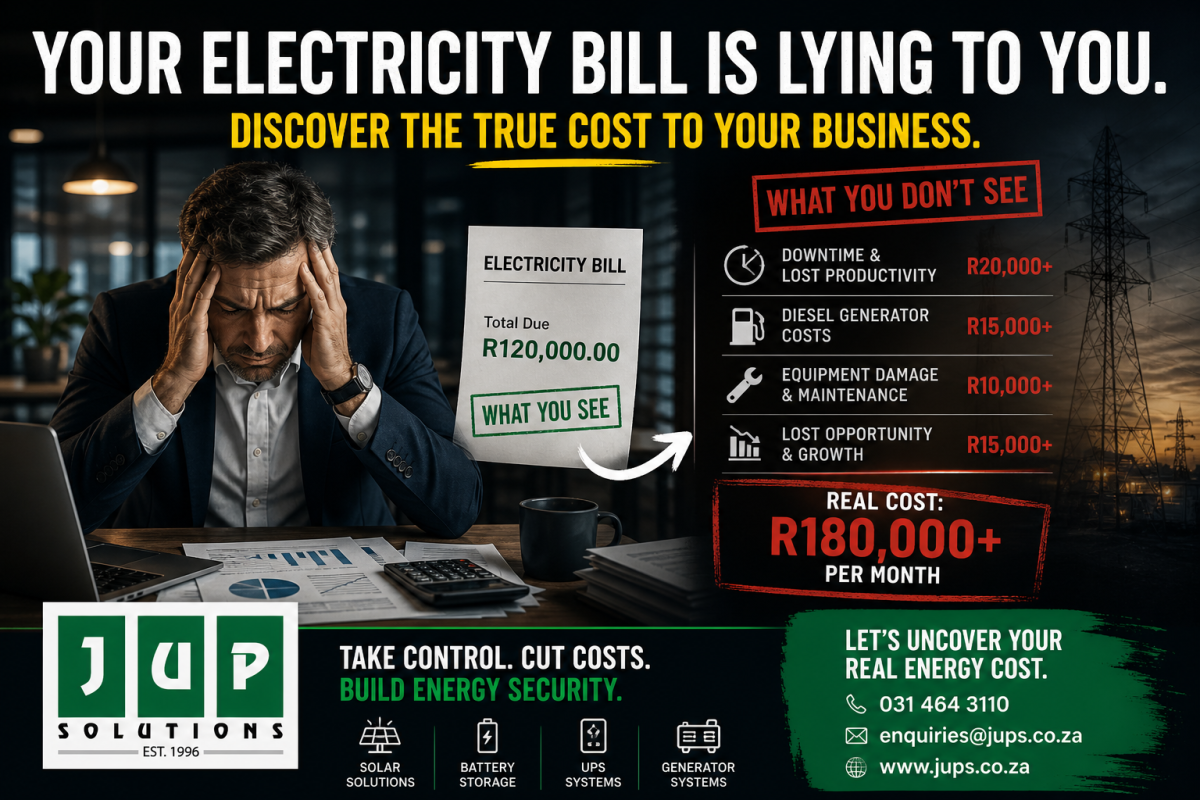
The Number You’re Watching Is the Wrong One
Most business owners think they understand their electricity costs.
They look at the monthly bill.
They compare it to last month.
They budget for the increase.
And they move on.
But here’s the uncomfortable truth:
Your electricity bill is not your real energy cost.
Not even close.
The Hidden Costs That Never Show Up on Your Invoice
Your utility bill only reflects what you pay for power.
It says nothing about what unreliable power is costing your business.
Let’s break it down.
1. Downtime That Doesn’t Get Recorded
When the power drops:
- Production pauses
- Staff stand idle
- Systems reboot
- Processes restart
You don’t see this on a statement but it’s costing you real money every time it happens.
2. Diesel Spend That Creeps Up Quietly
Generators feel like a safety net.
Until you calculate:
- fuel costs
- servicing
- wear and tear
- inefficiency at partial load
What looks like “backup” quickly becomes a second energy bill.
3. Equipment Damage You Blame on Something Else
Unstable power leads to:
- premature failure of motors and drives
- server and IT issues
- tripping systems
- unexplained faults
Most businesses replace equipment without ever linking it back to poor power quality.
4. Lost Opportunity Cost
Here’s the big one.
While you’re:
- paying rising tariffs
- absorbing inefficiencies
- reacting to outages
Your competitors may already be:
- generating their own power
- locking in energy costs
- operating more predictably
That gap compounds over time.
The Real Cost vs The Perceived Cost
Let’s look at a simple example:
Business A (No energy strategy):
- Electricity bill: R120,000/month
- Diesel: R15,000/month
- Downtime impact: ± R20,000/month
Real energy cost: ± R155,000/month
Business B (Grid-tied solar + structured standby):
- Electricity bill reduced by 35%
- Diesel usage reduced significantly
- Downtime minimised
Effective cost: ± R95,000/month
Difference:
R60,000 per month
R720,000 per year
Same industry. Same conditions.
Completely different outcomes.
Why Grid-Tied Solar Is Leading the Shift
For most commercial and industrial businesses, the smartest starting point is simple:
Reduce your reliance on expensive grid power first.
Grid-tied solar allows you to:
- use solar energy during operating hours
- cut monthly electricity costs immediately
- improve cash flow without complexity
- scale your system over time
No batteries required to start.
No major operational disruption.
Just consistent savings.
Then Layer in Control
Once your cost base is reduced, you can build resilience:
- UPS systems for clean, uninterrupted power
- battery storage for critical loads
- hybrid integration with generators
- intelligent load management
This is where energy shifts from expense to strategy.
The Biggest Mistake We’re Seeing in 2026
It’s not that businesses are ignoring energy.
It’s that they’re underestimating it.
They’re:
- waiting for clarity
- waiting for budgets
- waiting for the “right time”
Meanwhile, the cost of doing nothing keeps increasing quietly, consistently, and significantly.
What JUP Solutions Does Differently
We don’t sell solar.
We don’t sell backup.
We engineer energy systems that make financial sense.
That means:
- understanding your real load profile
- identifying hidden costs
- designing for both savings and resilience
- building systems that actually perform under pressure
Because the goal isn’t to install equipment.
The goal is to reduce your total cost of energy.
If you’re only looking at your electricity bill,
you’re only seeing part of the picture.
The real question is:
What is unreliable, expensive power actually costing your business every month?
Once you answer that honestly, the decision becomes much clearer.
Let’s Put Real Numbers to It
If you want to understand your true energy cost — not just what Eskom charges you — we’ll help you break it down properly.
📞 031 464 3110
📧 enquiries@jups.co.za
🌐 www.jups.co.za
Share this Post