
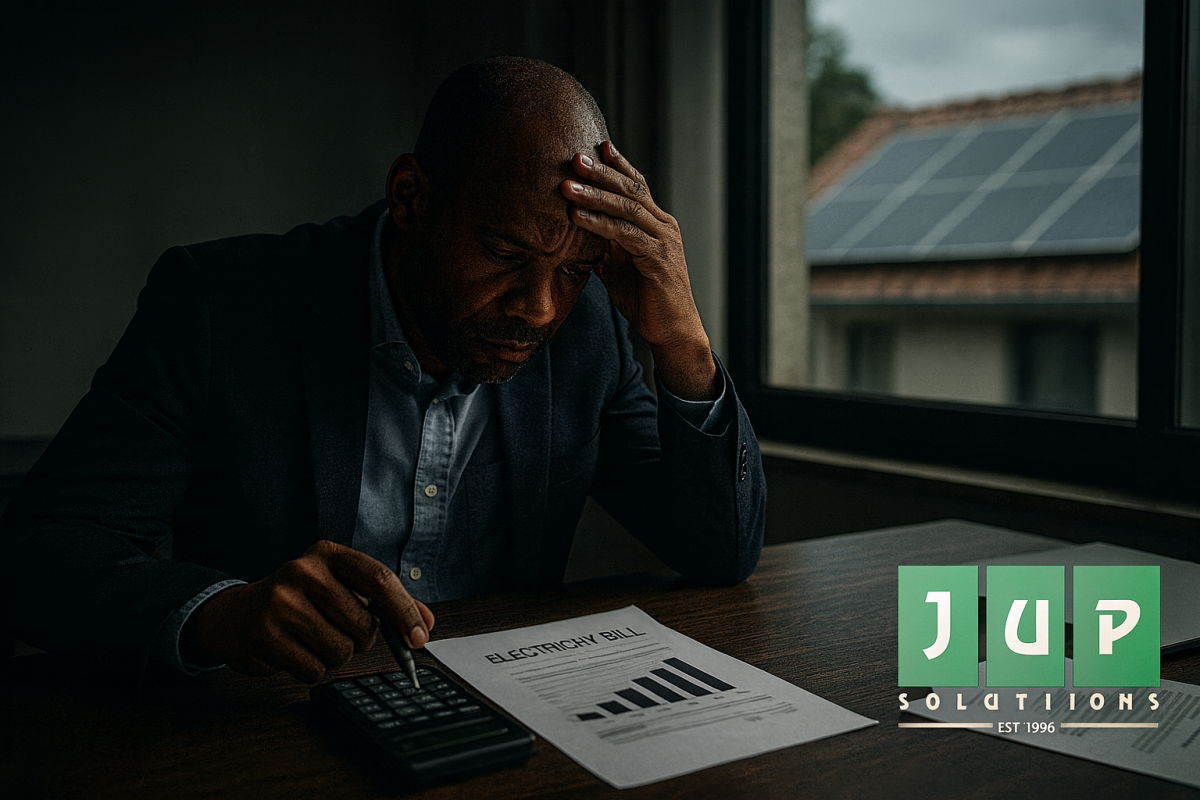
Most South African businesses know electricity is expensive and unreliable.
But many still treat energy as a grudge line item, not a strategic risk.
So they wait.
They wait for tariffs to “settle”.
They wait for load-shedding to “get better”.
They wait for “the right time” to invest in solar, batteries or proper backup.
In our partner article on Ashley Beggs Consulting, we unpacked the hidden costs of doing nothing about energy from a leadership and strategy point of view.
In this post, we’re looking at the same issue through the lens of PV solar and backup power and how delaying action quietly drains cash, resilience and opportunity from your business.
1. Tariffs Don’t Just Rise – They Compound
Every year you delay a solar or energy-efficiency project, you’re not just paying higher prices, you’re paying higher prices on a bigger base.
- Annual increases stack on top of previous ones
- Your usage usually grows with your business
- “We’ll look at it next year” turns into millions lost over five years
Doing nothing is still a decision. It just happens to be the most expensive one over time.
2. Load-Shedding Is a Direct Hit to Revenue
Most companies only look at their Eskom or municipal bill.
The real killer is the cost of downtime:
- Production lines stopping mid-run
- Point-of-sale systems down in peak trade
- Refrigeration and cold storage at risk
- Teams sitting idle while salaries still run
If you honestly cost out a year’s worth of interruptions, you quickly see that a properly designed PV + battery + UPS solution is often cheaper than the “do nothing” route.
3. Your Equipment Is Taking a Beating
Unstable power doesn’t just turn the lights off. It quietly damages electronics:
- Voltage dips and spikes shorten the life of motors, drives, servers and IT kit
- Emergency restarts can corrupt data and operating systems
- Cheap, undersized inverters and plug-in devices create more risk than they remove
Every unprotected brownout is a small withdrawal from the life expectancy of your equipment.
A well-engineered standby power and conditioning system (UPS, quality inverters, surge protection) saves you from those “surprise” capex hits.
4. You’re Losing Competitiveness While Others Adapt
Your competitors aren’t all waiting.
The ones investing in PV solar, Enphase-based hybrid systems and smart energy management are:
- Locking in lower, more predictable operating costs
- Staying open during load-shedding
- Using their energy resilience as a selling point with customers and investors
Staying fully grid-dependent doesn’t keep you “neutral”. It slowly pushes you up the cost curve and down the competitiveness curve.
5. ESG, Tenders and Finance Are Moving On Without You
Banks, landlords, large corporates and even export markets are quietly tightening expectations around:
- Carbon footprint and renewables
- Energy resilience and risk
- ESG reporting
When your business has no plan for energy and sustainability, it starts to show up in:
- Lost tenders
- Tougher funding conversations
- Being left out of preferred supplier lists
Solar and storage are no longer “green PR”. They’re becoming entry-level hygiene for serious businesses.
6. The Human Cost: Morale, Safety and Trust
Constant outages affect people too:
- Staff get frustrated when they can’t work properly
- Safety systems and lighting may fail if backup is poor
- Customers lose trust when they repeatedly find you “offline”
Reliable power is a workplace and brand experience issue as much as it is a technical one.
So What Does “Doing Something” Actually Look Like?
It doesn’t have to start with a massive capex project.
At JUP Solutions, we typically walk clients through:
- Energy & Risk Assessment
- Understand where and when you use power
- Identify critical loads vs nice-to-have loads
- Quantify what downtime is really costing you
- Quick Wins
- Clean up unsafe or inefficient backup setups
- Right-size existing UPS and generator solutions
- Add proper surge and power conditioning where needed
- PV Solar & Hybrid Design
- Introduce roof or ground-mount PV sized for your reality
- Use Enphase microinverters and modern batteries where appropriate for maximum safety, flexibility and monitoring
- Design for staged rollout if budgets are tight
- Monitoring & Continuous Improvement
- Track actual savings and performance
- Adjust loads and schedules based on real data
- Build a roadmap for future expansion (more PV, more storage, less diesel)
The goal is simple: spend less on crisis and waste, more on assets that pay you back.
The Real Question Isn’t “Can We Afford Solar or Backup?”
It’s this:
How long can we afford to keep doing nothing?
If your business is serious about resilience, cost control and staying investable, energy can’t sit on the “later” pile anymore.
Let’s put a number on the hidden cost of doing nothing in your organisation – and then design a better plan.
JUP Solutions
Stop reacting to the grid. Start leading your energy strategy.
Share this Post