
South Africa’s electricity conversation has changed.
For years, businesses focused almost entirely on one question: “What happens when the power goes off?”
In 2026, that is no longer enough.
As South Africa experiences improved overall grid availability, the next energy risk deserves far more attention: the quality of the electricity reaching your business.
Your lights can be on. Your machinery can be running. Your computers can appear perfectly normal.
But that does not necessarily mean the electricity supplying them is stable, clean or within the tolerances your equipment was designed to handle.
So perhaps the more important question for South African businesses today is:
What happens to our business when power quality isn’t perfect?
What Is Power Quality?
Power quality describes how consistently the electricity supplied to your equipment remains within acceptable electrical parameters.
Problems can include:
- Voltage dips and sags
- Overvoltage
- Voltage fluctuations
- Electrical surges and transients
- Harmonic distortion
- Frequency variations
- Short interruptions
- Switching disturbances
Some are immediately obvious. Others can occur repeatedly without anyone noticing.
That is what makes poor power quality particularly dangerous.
A complete outage gets everyone’s attention.
A recurring voltage disturbance may quietly damage equipment for months before the underlying cause is identified.
Why Power Quality Matters More in 2026
Modern businesses are becoming increasingly dependent on sensitive electronic equipment.
Manufacturing facilities use PLCs, variable-speed drives, automation and control systems.
Offices depend on servers, networks, cloud connectivity and communications equipment.
Retail businesses rely on point-of-sale systems, security, refrigeration and connectivity.
Healthcare, hospitality, logistics, telecommunications and data-driven businesses have their own critical loads.
As our businesses become more digital and automated, our tolerance for poor-quality electricity becomes smaller.
A disturbance lasting only seconds can potentially interrupt a process that takes considerably longer to restore.
The Hidden Cost of Poor Power Quality
This is where the conversation becomes a financial one.
The cost of poor power quality isn’t necessarily shown as a line item on your electricity account.
Instead, it can appear elsewhere in the business.
1. Premature Equipment Failure
Repeated electrical disturbances can place additional stress on sensitive components and contribute to premature equipment failure.
When an expensive drive, controller, power supply or piece of electronic equipment fails, businesses naturally look at the component itself.
The incoming power supply should also be part of that investigation.
2. Unplanned Downtime
A power-quality event does not necessarily need to cause a blackout to stop production.
If a sensitive machine, server or control system trips, the financial consequence can include:
- Lost production
- Idle employees
- Restart procedures
- Product losses
- Missed deadlines
- Customer disruption
For some businesses, even a few minutes of disruption can cost considerably more than the electricity consumed during that period.
3. IT and Data Disruption
Servers, networks, telecommunications equipment and other digital infrastructure require reliable power.
An unexpected interruption or electrical disturbance can cause systems to restart, communications to fail or processes to be interrupted.
As South African businesses become increasingly digital, power resilience and IT resilience are becoming inseparable.
4. Increased Maintenance Costs
If electrical components fail more frequently than expected, the business pays twice.
First for the replacement or repair.
Then for the disruption associated with the failure.
Repeatedly replacing equipment without investigating the quality of the supply feeding it can become an expensive cycle.
“But We Already Have a Generator”
A standby generator remains an extremely important part of many business continuity strategies.
But a generator and a power-quality solution perform different functions.
A generator is principally designed to provide an alternative source of electricity when the normal supply fails.
Depending on the application, a business may also require equipment such as:
- Uninterruptible Power Supply (UPS) systems
- Surge protection
- Voltage regulation
- Power conditioning
- Battery Energy Storage Systems (BESS)
- Automatic transfer systems
- Power monitoring
- Correct protection and distribution infrastructure
The solution depends entirely on the load being protected.
There is no universal backup-power architecture suitable for every business.
The UPS Is Becoming More Important, Not Less
With reduced load-shedding, some businesses may question whether they still need their UPS infrastructure.
For critical applications, that can be the wrong conclusion.
A correctly specified UPS does considerably more than provide battery runtime during an outage.
Depending on the UPS topology and application, it can provide critical equipment with continuity and protection from disturbances in the incoming supply.
That makes UPS technology particularly relevant for:
- Data and server environments
- Telecommunications
- Medical equipment
- Process control
- Industrial automation
- Financial systems
- Security infrastructure
- Other mission-critical electronic loads
The purpose is not simply to keep something running during load-shedding.
It is to provide the quality and continuity of power the application requires.
Solar and Batteries Don’t Automatically Solve Power Quality
South African businesses have invested heavily in solar PV and battery storage over recent years.
These technologies can deliver significant financial and resilience benefits.
But adding solar panels or batteries to a facility does not automatically resolve every electrical problem.
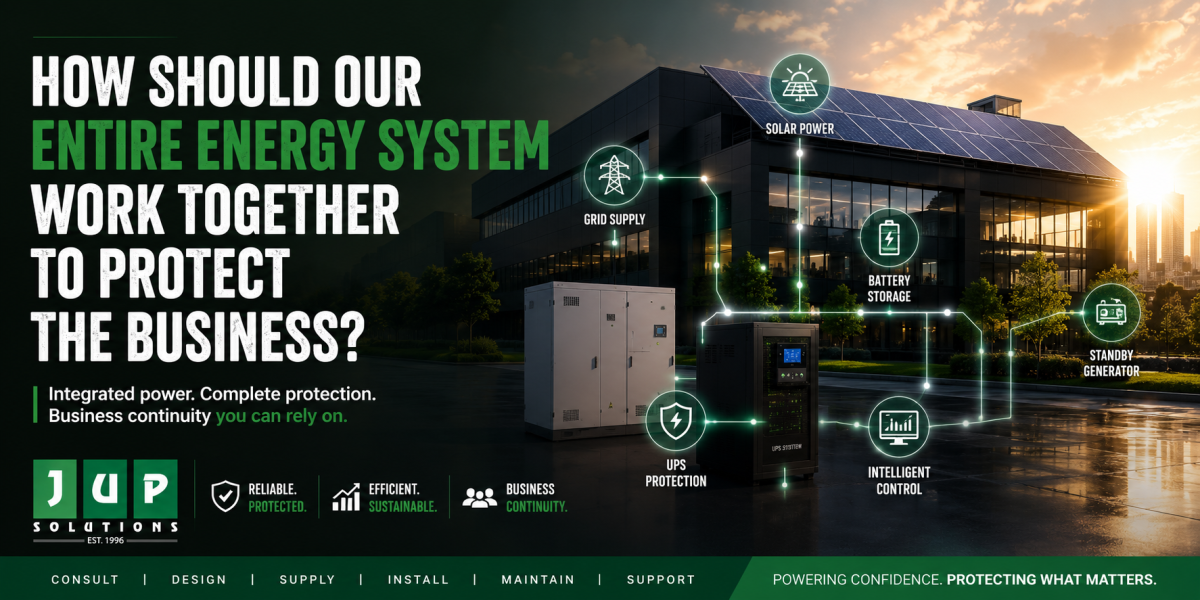
Grid supply, solar PV, batteries, UPS systems and generators all need to work together within a correctly engineered electrical architecture.
This is why JUPS believes the next phase of the South African energy market will increasingly be about integration rather than individual products.
The question is no longer simply:
“Which inverter should we buy?”
It should be:
“How should our entire energy system work together to protect the business?”
From Backup Power to Energy Resilience
This represents an important shift.
Historically, businesses purchased standby power primarily as insurance against outages.
The modern objective is broader:
Build an energy system that is reliable, efficient, maintainable and appropriate for the operational risk of the business.
That may combine:
GRID + SOLAR + BATTERY + UPS + GENERATOR + INTELLIGENT CONTROL
Each performs a different job.
Grid power provides the primary supply.
Solar can materially reduce purchased electricity.
Battery storage can provide energy flexibility and backup.
UPS infrastructure protects critical loads from interruption.
Generators provide extended standby capacity.
Monitoring provides the information required to understand what the entire system is actually doing.
When these technologies are correctly engineered to operate together, the result is not simply “backup power.”
It is energy resilience.
Do You Actually Know What’s Happening to Your Power?
This may be the most important question in this article.
If your business experiences:
- Unexplained equipment failures
- Frequent nuisance tripping
- Electronics failing prematurely
- UPS alarms
- Unexpected machine resets
- Generator or transfer problems
- Intermittent IT failures
don’t automatically assume the equipment is faulty.
The problem may be upstream.
Proper measurement and analysis can help establish what is actually happening within the electrical environment before money is spent solving the wrong problem.
The JUP Solutions Approach
JUP Solutions has been working in standby and critical power since 1996.
Over that time, the technology has changed dramatically.
The principle hasn’t.
Critical businesses need reliable power.
Today that means looking beyond individual products and understanding the complete electrical environment.
Our solutions include:
- UPS and critical power systems
- Standby generator solutions
- Solar PV
- Battery storage
- Hybrid energy systems
- Power monitoring
- Preventative maintenance
- 24/7 standby support for contracted customers
Most importantly, we approach these technologies as parts of one engineered energy system.
Don’t Wait for the Power to Go Off
The next serious energy problem affecting your business may not be another round of load-shedding.
Your electricity may stay on.
Your monthly account may arrive as normal.
Everything may appear fine.
Until a critical system trips, equipment fails or production suddenly stops.
That’s why the energy conversation in 2026 needs to evolve.
Don’t only ask whether you have power.
Ask whether you have the right quality of power, the right protection and the right resilience behind your business.
Is Your Business Properly Protected?
If you are unsure about the condition of your existing UPS, standby or energy infrastructure, or you’re planning an upgrade, speak to JUP Solutions.
We’ll help you understand the risk first, then engineer the appropriate solution.
JUP Solutions
Expertly engineered standby & renewable power since 1996.
Share this Post